Why I Built a Sandbox with AI
Announcing: The Fictivize Project
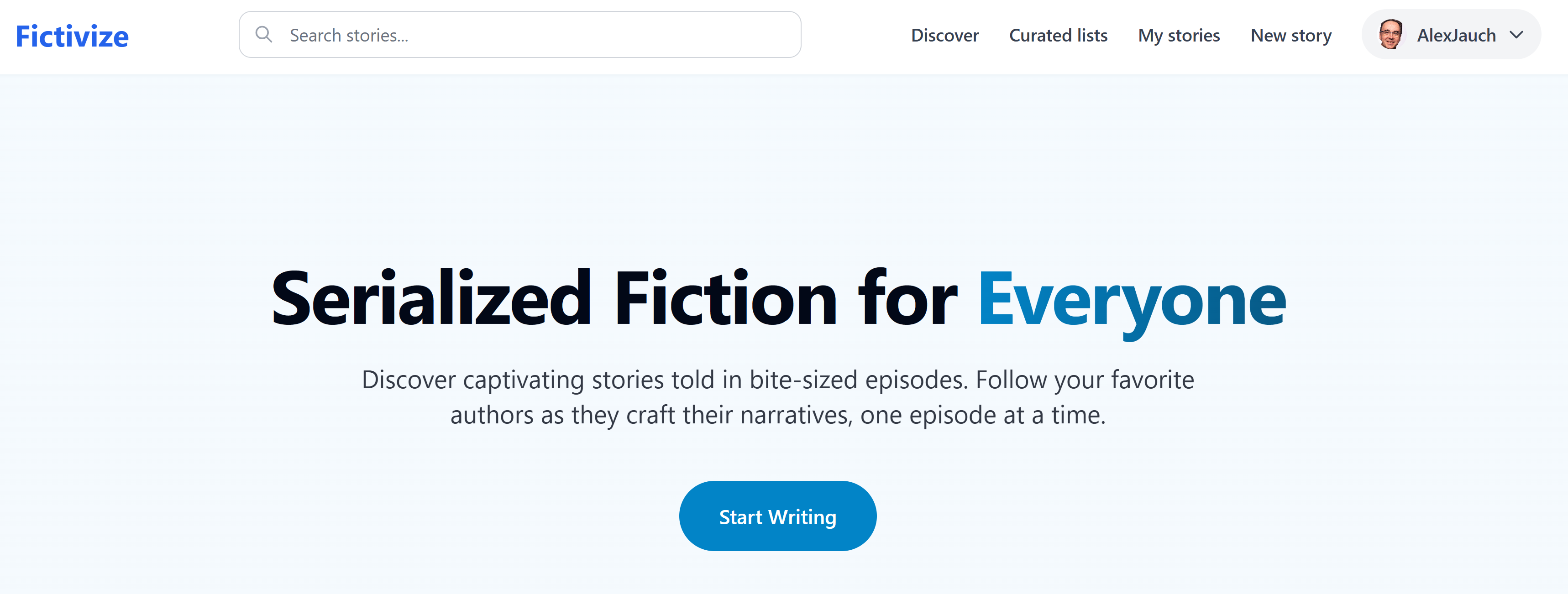
I am very pleased to announce that the Fictivize project is ready to come out of development and is now in preview. Please check it out at www.fictivize.com.
What is Fictivize? Fundamentally, Fictivize is two projects in one. First, Fictivize is a laboratory. I gave myself the goal of building a complete end-to-end SaaS site on my own with no engineering support using an AI-based toolchain. For those of you who read my blog, you'll know that I've been working on this for some time. The second goal was to create a site that authors can use to publish serialized fiction. Again, if you follow me online, you'll know that I'm an author and I've written several books including the novel The Kidd Incident.
The issue that I ran into when attempting to write a novel is that the "traditional" pathway for authors is actually very poor and most authors fail. If you speak to aspiring authors, you'll find that the vast majority of them give up before they complete their novel. This is a shame because it means that there are great stories out there that people want to tell, but they just can't because the process is too difficult.
As a product person, this bothered me in a very fundamental way. I have spent the last twenty years focused on usability and utility -- creating products that allow customers to achieve their goal. Thus, talking to people who are failing to reach their goals makes me want to help them. The other thing that my career in software taught me is that if you're failing, you stop and investigate what you're doing, why you're doing it and keep digging until you get to the root of the problem.
So, I did.
As I did research, I found out that the way you're "supposed" to write fiction (get a great idea, go write an amazing novel and sell it to a publisher) isn't actually the only way, or even the best way. Many people created their first novels in completely different ways. I was reading Nathan Lowell's excellent Solar Clipper series and was astounded to find out that it was originally a podcast. Then, my wife gave me a copy of the complete Sherlock Holmes. I did some research and found out that these stories were originally released as series in magazines. I later found out that The Martian by Andy Weir was originally written as a serialized, chapter-by-chapter story also.
I realized that writing one episode a week was much more approachable than trying to write an entire novel. So I decided to do that and this is how The Kidd Incident was born. I'm a relatively technical guy, so buying a domain name and creating a website for The Kidd Incident was pretty easy for me. I used a WordPress site and just started writing. I talked about this process online and people started reading it. I developed a large community of readers who were interested in the story and they helped me develop the story further. They offered suggestions, corrections and encouragement. Eventually, it evolved into a full novel (over 100k words) and it is available on Amazon for Kindle and as a paperback.
Because of this experience, I had a pretty strong opinion that writers were not being well served by the existing book publishing process. It was a problem that I understood and I felt I knew how to solve. As a product person, that's exactly what I'm always looking for. Is this problem real? Well, yes, it was for me and I've met others who have the same problem. Can I solve this problem? Yes, I think so, I solved it for myself and others could benefit also.
I am the kind of person that learns by doing. You can sit and talk to me all day about AI and developer toolchain, but I won't really understand what you're trying to tell me until I actually do it myself. Hence, I needed to build an actual SaaS site myself so I could find out how to do it. And, boom, Fictivize was born.
That leads us to the second half of Fictivize's mission: Act as a laboratory for AI toolchain. Fictivize is a complete AI centric sandbox for SaaS product development. You could build almost any SaaS site with it, but I chose to build a product I was passionate about.
Unlike tales of "vibe coding," Fictivize was built using AI toolchain but maintaining all of the discipline and structure that I've learned from building SaaS sites over the past fourteen years. It has a strict security policy, it has a CI/CD pipeline, it has a detailed testing strategy, it uses a microservices architecture, etc. All the things that I would put into requirements documents for a business-class SaaS application were put into the requirements for Fictivize. The only difference is that AI wrote all the code.
And this is the point I'd like to focus on: AI does not fundamentally change the laws of physics. You still need testing. You still need a release pipeline. You still need architecture. All the things we learned in the past twenty years of building websites are still true. The only difference is the toolchain we use and the speed at which a small team can move.
Going forward, I will be using Fictivize as a working classroom and will be developing training and other materials for the product management community. Anyone who has a good idea for a new site can use this same framework and create something that works and will survive over the long term.
Is Fictivize perfect? No, certainly not. Just like the original The Kidd Incident draft, Fictivize needs work. Tons of work. The reason why I'm opening it up to preview is to get feedback from people like you. I'll take that feedback and iterate. Just like any product team would do.
Ship early, ship often. This is the way.